Raised underfoot, homed with care
We are a small, single-breed household cattery. Everything here is built around one idea: that a kitten who grows up inside a busy family becomes a cat who is easy to live with.
A breed that began with
one curly kitten.
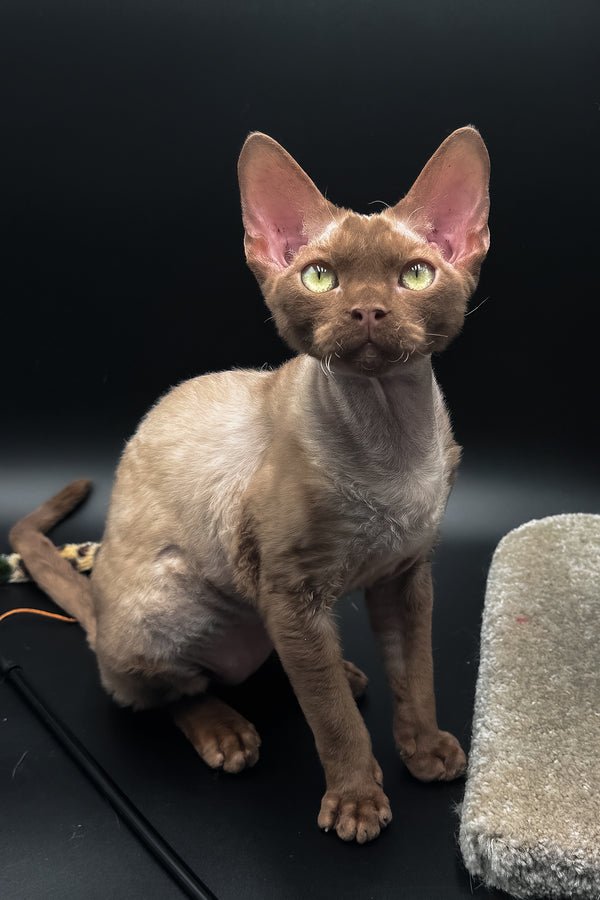
In 1959, in Buckfastleigh in Devon, a woman named Beryl Cox took in a stray tom with an unusual wavy coat. One of the kittens that followed, a curly brown-black male, was named Kirlee – and every Devon Rex alive today descends from him.
At first Kirlee was assumed to carry the same gene as the Cornish Rex, discovered a few years earlier just one county away. Test matings proved otherwise: the two curls come from entirely separate recessive genes. Kirlee was not a variation on an existing breed. He was the start of a new one.
The breed was recognised in Britain in 1967 and in North America in 1979. That elfin face, those enormous low-set ears and the suede-soft rippled coat all trace back to a single stray cat in a Devon field.
A small programme,
on purpose.
We have bred Devon Rex for over a decade, and we deliberately keep the programme small. Our queens live as family cats, not as breeding stock – they sleep on beds, supervise the cooking and retire here when their time comes.
We run a handful of carefully planned litters a year. That means we can raise every kitten in the middle of the household rather than in a separate room: near the washing machine, the doorbell, the television and the people. By the time a kitten leaves, ordinary life holds no surprises.
- A small number of planned litters each year
- Queens live as family pets and retire with us
- Kittens reared in the main living space
- Daily handling from the first week
- Parents DNA-tested and heart-screened
- Never more than one breed
How we adopt, and why
Ethical breeding is mostly a series of small refusals. These are ours.
- No kitten leaves before twelve weeks. Early separation costs a cat confidence it never fully recovers. We will not do it, however much someone would like to collect sooner.
- We health-test the parents, not just the kittens. Both parents are DNA-tested clear for Devon Rex congenital myasthenic syndrome and screened for hypertrophic cardiomyopathy by echocardiogram.
- We ask questions, and we sometimes say no. A conversation about your home, your hours and your other animals is not a formality. Occasionally the honest answer is that a Devon Rex is the wrong cat for a household.
- Companion homes are neutered. Older kittens go home already neutered; younger ones go with a written agreement to arrange it at the right age.
- Our cats come back to us, always. If your circumstances change at any point in that cat’s life, you return them here rather than rehoming elsewhere. No questions, no judgement, no time limit.
- We do not ship kittens as cargo. Homecoming happens in person, or through a reputable accompanied courier where distance truly requires it.
Three things you can hold us to
An honest health record
You get the full picture, including anything imperfect. Every vet visit, every vaccination date, every note - and a written health guarantee behind it.
A straight conversation
We will tell you if a kitten is not the right fit, if you would be better waiting for the next litter, or if the breed does not suit your household at all.
Support that does not expire
Message us at three days or at nine years. We answer questions about our cats for as long as they live, because they were ours first.
Think a Devon Rex is right for you?
Tell us about your home and we will tell you honestly whether this is the breed for you – and which of our kittens would suit you best.